AI Agent 007: Inter-IIT Techfest
Published:



🏆 Achievement
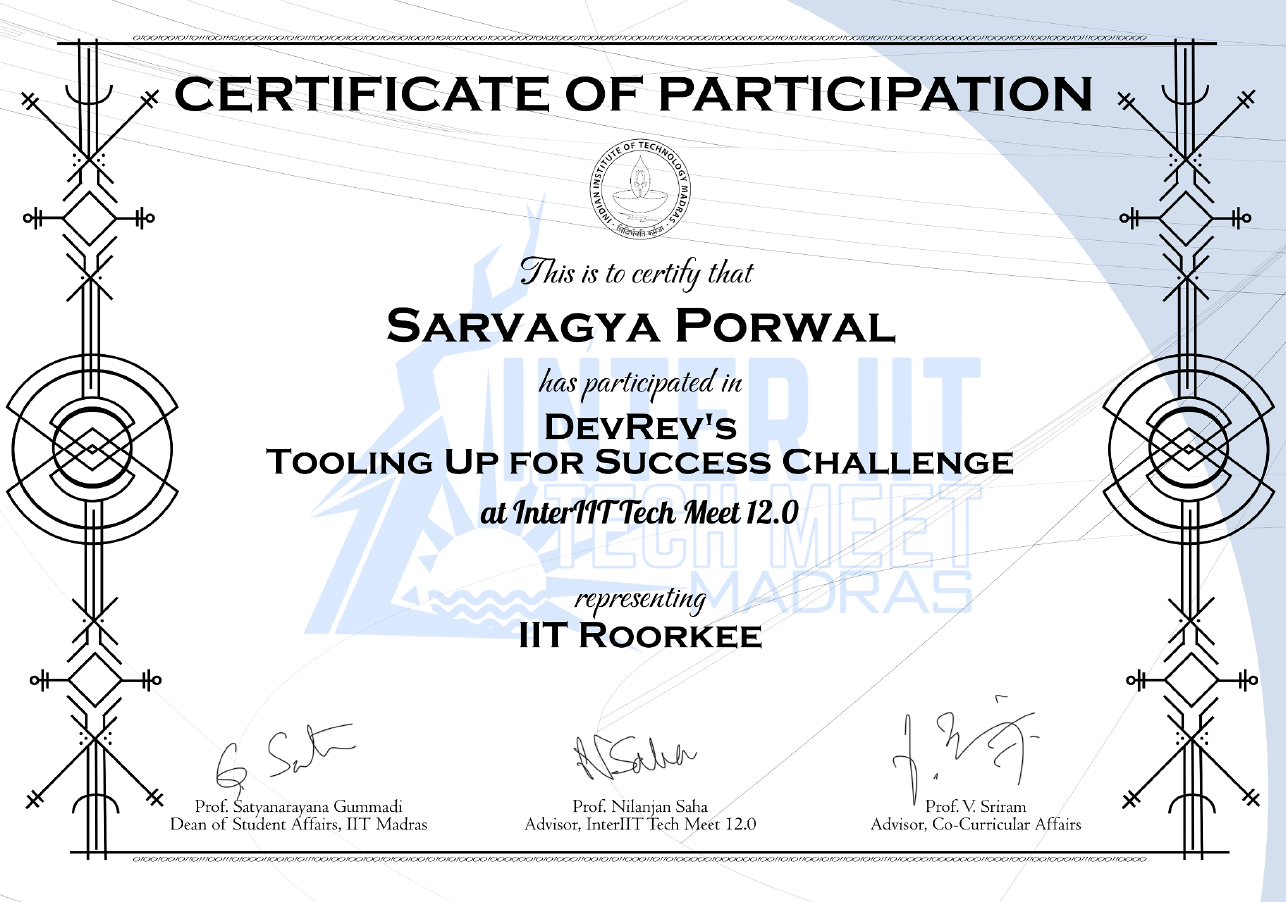
Secured Rank 3 in the Tooling up for Success challenge at Inter-IIT Techfest 2023. Competing in the DevRev AI Agent Track against top Indian technical institutes, our solution excelled in autonomous tool management and complex query resolution.
🤖 The Challenge
The objective was to build a “query-aware” agent capable of intelligently allocating tasks to specific tools and reviewing their outputs without human intervention. The core difficulty lay in handling multi-step dependencies and preventing the agent from repeating past logic errors.
🧠 Architecture: Advanced Reasoning & Memory
We moved beyond simple linear chains to create a robust, self-correcting system:
1. Graph-Based Query Decomposition
Instead of processing tokens linearly, the agent parses complex user queries into a Directed Acyclic Graph (DAG).
- Topological Execution: Tasks are executed in a dependency-aware order.
- Context Linking: The output of a parent query is automatically passed as context to the child query, ensuring seamless data flow across multi-step reasoning.
2. Robust ReAct with Critique & Fallback
I implemented a modified ReAct (Reason + Act) loop designed for resilience:
- Critique Module: After every tool execution, the agent critiques the output quality.
- Fallback Mechanism: If a tool returns unsatisfactory results, the agent triggers specific fallback routines rather than hallucinating an answer.
3. Self-Reflection via RAG (Long-Term Memory)
To prevent the agent from making the same mistake twice, we engineered a “Self-Reflective Pipeline”:
- Experience Retrieval: The system uses RAG (Retrieval-Augmented Generation) to access a long-term memory store of past execution logs.
- Error Avoidance: Before taking action, the agent searches for similar past failure scenarios and adjusts its prompt strategy dynamically to avoid repeating those specific mistakes.
🔗 Links
📸 Visual Library
Agent decision flowcharts, DAG visualization, and terminal logs of “Thought-Act-Observation” loops.